April 17, 2026
"Landlords spend $100M+ on the building but we still can't get a decent floor plan"
A costly blind spot in office marketing

I believe that CRE marketing is far behind other industries. And when I recently mentioned this to an SVP tenant-rep broker at CBRE, he put it perfectly:
Landlords spend hundreds of millions on these buildings, but we sometimes still can't get a decent floor plan.
That line stuck with me because it cuts to something most owners miss: The fundamental disconnect between what they'll invest in their property and what they'll invest in showing it properly.
The tenant rep perspective
From where tenant-reps sit, this gap shows up constantly. They're trying to present options to clients who need to make decisions quickly, sometimes remotely or with limited site visits. A well-executed floor plan isn't decoration. It's the difference between a space that reads clearly and one that creates confusion.
But here's what my friend was really getting at: some of the owners who'll spend heavily on premium finishes and building systems treat marketing materials as an afterthought. The assumption seems to be that the building will sell itself, or that competent brokers should be able to work with whatever materials exist.
The real problem behind poor marketing materials
This problem isn't that these owners are cheap. It's that they have a bias that runs deeper than budget decisions. Over decades of operations they've come to see marketing as a box to check, or something brokers handle, not a core business function that affects their bottom line.
The logic goes something like this: "We've built a great space, the market knows quality when it sees it, and good brokers will figure out how to present it."
It sounds reasonable until you realize it puts your property at a systematic disadvantage. Generic marketing approaches turn buildings into commodities competing on price alone, which completely wastes the differentiation you spent millions trying to create.
When tenants see marketing materials that all look template-y and identical - they default to comparing on the metrics that are easy to measure: price per square foot, location, basic specs. That's exactly where you don't want the conversation to go if you've invested in creating something distinctive and achieving above-average results.
What this bias actually costs building owners
The financial impact isn't always obvious, but it's real. Poor marketing materials create friction in the leasing process that shows up in longer vacancy periods, more price negotiations, and reduced broker enthusiasm for your property.
Think about it from a tenant's perspective: they're looking at a dozen similar spaces before deciding which ones warrant a visit. If your materials don't make a strong first impression, you might not even make it to the shortlist. The millions you spent on the building never get a chance to do their work because prospects have already moved on.
More subtly, this bias affects how your property is perceived by the brokerage community. When materials are hard to get, hard to work with or don't tell the story effectively, it signals that the owner doesn't care. And owners that don't care usually means bad buildings that brokers would rather avoid.
Why brokers silently favor certain properties
Here's something not everybody realizes: brokers on both sides of the market develop preferences for certain buildings and owners, often based on factors that have nothing to do with the space itself.
Just like buildings with responsive and attentive ownership, properties with clear, professional marketing materials get presented more often and more enthusiastically. When a tenant rep can easily explain a space to their client, or when a landlord rep has materials that make their presentations smooth, those properties naturally get more attention.
The same principle applies to how buildings target their ideal tenants – clear positioning and presentation create momentum that compounds over time.
It's natural - Brokers gravitate toward buildings and owners that make their jobs easier and their presentations more compelling. Those that remove friction from the process.
How to break this expensive pattern
The fix isn't complicated, but it requires recognizing that marketing isn't separate from your leasing strategy. It's part of the same investment thesis that justified spending millions on construction and improvements.
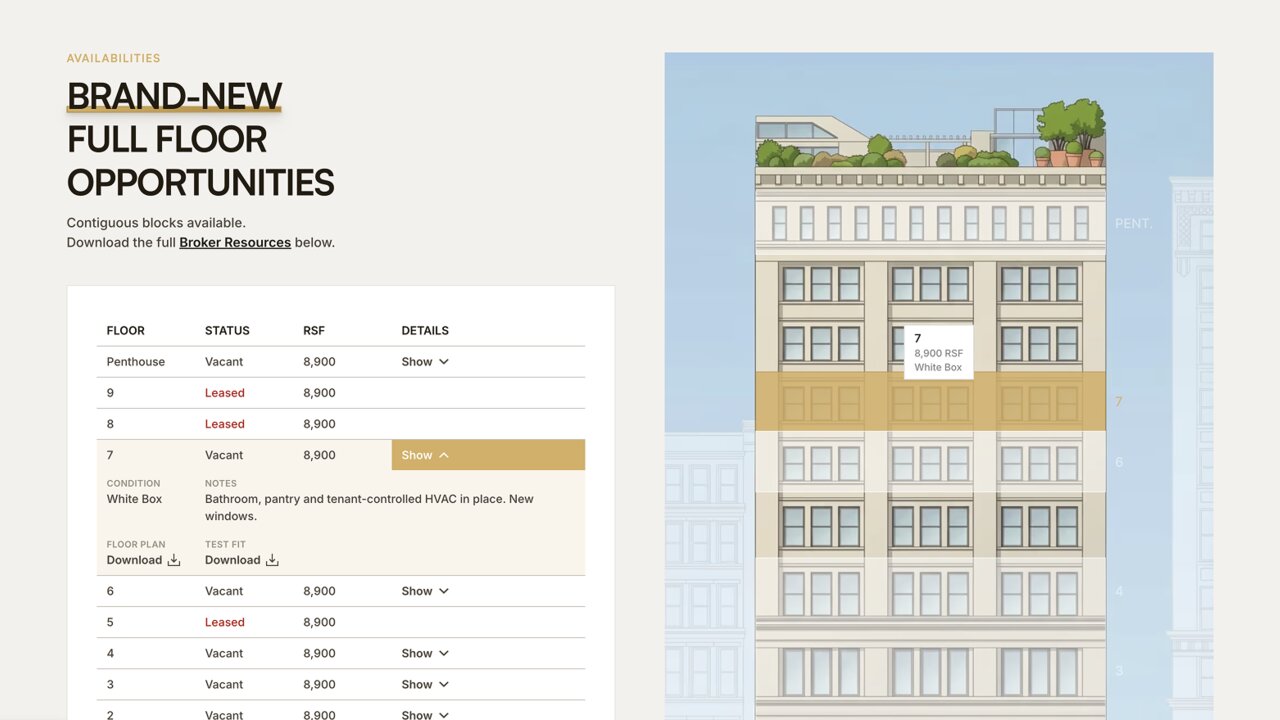
Start with the materials brokers actually use: good pictures, floor plans and test fits. The first goal is to make them clear, complete, and easy to work with.
Because when you make it easy for brokers to present your space effectively you're changing your position in the market.